
Labels Make Workflows Work

Hospitals and pharmacies rely on sophisticated systems to keep operations moving. Prescription platforms, EHRs, medication management tools, laboratory systems, admissions systems, and inventory processes all generate critical information that supports speed, safety, and accuracy.
But information alone does not move care forward.
It has to connect to the real world.
That connection is the label.
Labels are often treated as a small purchase, a standard supply, or a commodity line item. In reality, they are one of the most important operational links in healthcare. They connect technology to patients, medications, specimens, supplies, inventory, and the countless real-world workflows that happen every day in hospitals and pharmacies.
Without labels, the systems still hold the data, but the work breaks down. Staff lose the reliable physical connection that keeps the right information attached to the right item, person, or process. That affects speed. It affects organization. Most importantly, it affects safety.
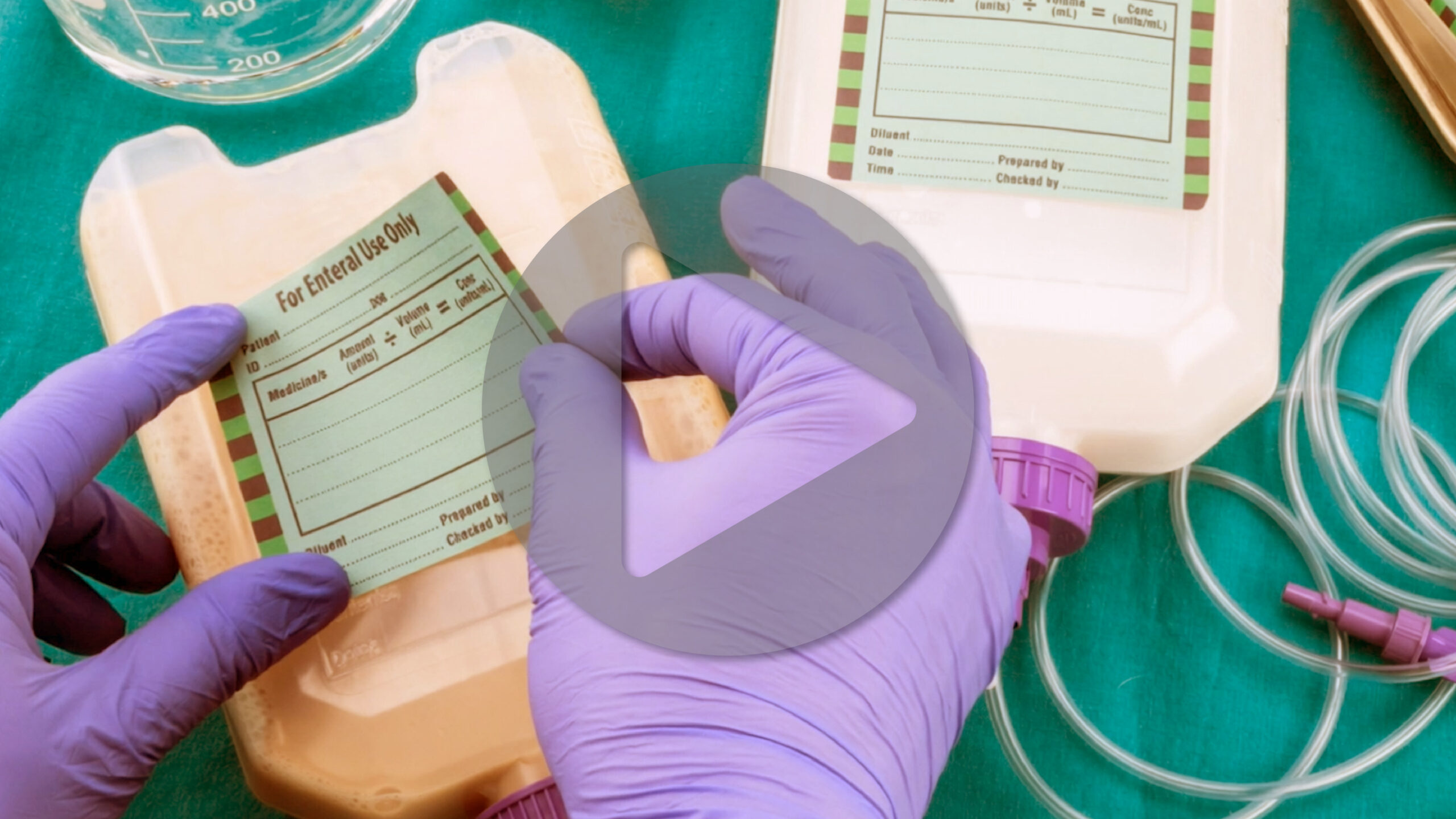
See how high-volume healthcare operations stay fast and accurate.
Watch how the right label solutions keep critical information connected at every step—from intake to pickup.
Technology only works when the workflow does
Healthcare organizations invest heavily in systems designed to improve accuracy and efficiency. But those systems do not operate inside a vacuum. Their output must be translated into something physical, visible, machine-readable, and durable enough to move through demanding real-world environments.
Labels make that possible.
They help connect digital information to medication containers, wristbands, specimen tubes, shelves, bins, IV bags, patient records, packaging, and workflow checkpoints. They carry the data forward so staff can identify, scan, sort, verify, route, and act with confidence.
That is what makes labels more than a printed output. They are the interface between digital intelligence and real-world execution.
In hospitals, labels help support safe and coordinated care
Across a hospital, labels support nearly every function. They help connect patient identity to the bedside. They help medications stay correctly identified from pharmacy to administration. They help specimens remain traceable through laboratory workflows. They help supplies and assets stay organized, visible, and usable across departments.
When labels perform well, hospital teams can move with more confidence. Nurses, pharmacists, lab teams, admissions personnel, surgical staff, and supply chain teams all depend on accurate identification and reliable workflow continuity to do their jobs effectively.
And because hospital environments are demanding—labels cannot just exist, they have to perform. They need to remain readable, scannable, and durable in harsh conditions where failure can interrupt care and increase risk.
In pharmacies, labels make digital workflows operationable
For pharmacies, labels serve a different but still critical function. Prescription systems may generate dosage instructions, patient information, barcodes, routing data, and inventory identifiers, but that information only becomes operational when it is attached clearly and reliably to the prescription, package, bin, shelf, or product moving through the workflow.
Labels support identification, dispensing, verification, organization, and fulfillment. They help maintain continuity from intake to fill to handoff. They support high-volume, high-speed workflows that require accuracy at every step.
Before a label ever informs the patient, it first supports the pharmacy upstream by helping staff identify, verify, organize, and move prescriptions correctly.
Labels are a small product with an outsized operational role
It is easy to underestimate labels because they are used everywhere. But that is exactly why they matter.
Hospitals and pharmacies do not run on software alone. They do not run on supplies alone, either. They run on the connection between systems and action. Labels are a foundational part of that connection.
They help ensure the right information follows the right patient, medication, specimen, supply, or prescription at every step. They help people trust the workflow. They help technology do its job in the physical world.
At Shamrock Labels, we understand that labels are not an afterthought. They are a critical part of how healthcare operates.
Because labels do more than carry information.
Labels make workflows work.