
Medical-Grade Labels Are Not Office Supply Labels
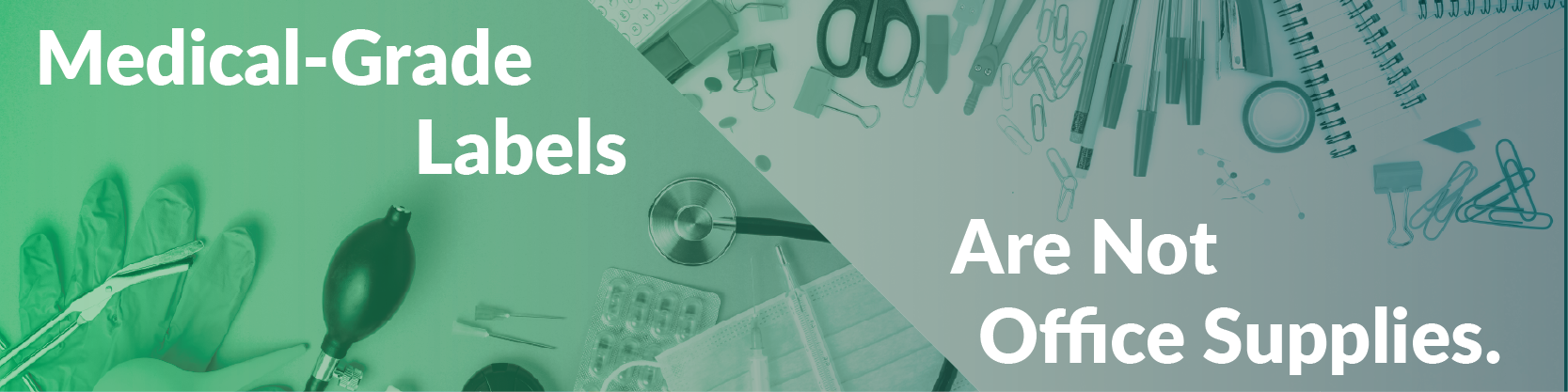
Engineered for Healthcare. Built for Reliability. Designed for Patient Safety.
In hospitals, surgery centers, and physician offices, labels are not simple office supplies.
They are critical tools that support patient identification, medication safety, specimen accuracy, regulatory compliance, and workflow efficiency.
Medical-grade labels are engineered for clinical environments — and choosing the right ones matters.
Why Healthcare Labels Are Different
Unlike standard office labels, medical-grade labels are designed for specific healthcare applications. Every component is purpose-built for performance in demanding environments.
✔ Specialized Facestocks
The face material of a medical label is selected based on how and where it will be used:
- Flexible materials for curved vials and syringes
- Durable constructions for surgical trays and equipment
- Moisture-resistant options for refrigerated medications
- Tear-resistant wristband materials for patient identification
✔ Application-Specific Adhesives
Healthcare adhesives are formulated to:
- Adhere securely to plastic, glass, metal, and film surfaces
- Remain bonded through refrigeration, freezing, or sterilization
- Resist alcohol wipes and cleaning chemicals
- Be gentle and comfortable when applied to skin
✔ Optimized Liners for Clinical Printing
High-volume hospital environments require smooth, consistent feeding through thermal printers. Proper liner construction prevents:
- Printer jams
- Label misalignment
- Downtime during critical workflows
Designed for Real Clinical Environments
Hospitals are not climate-controlled office spaces. Labels in healthcare must withstand:
- Alcohol and disinfectants
- Blood, fluids, and condensation
- Refrigeration and freezer storage
- Sterilization cycles
- Frequent handling and transport
Office supply labels simply are not engineered for these conditions.
Medical-grade labels are tested for durability so that critical patient information remains intact and readable.
Built for Human and Barcode Readability
Modern healthcare depends on barcode scanning and EHR integration.
Medical labels must:
- Produce sharp, high-contrast barcodes
- Remain scannable after exposure to moisture or chemicals
- Resist smudging from hand sanitizer or alcohol
- Maintain clarity under clinical lighting
When barcodes fail, workflows slow down — and patient safety is put at risk.
Reliable print performance is not optional.
Supporting EHR & Regulatory Requirements
Healthcare labels often contain highly specific, compliance-driven information:
- Patient identifiers
- Barcodes tied to EHR platforms
- Medication details and warnings
- Collection dates and timestamps
- Regulatory or accreditation-required data
Medical-grade labels are designed to support accurate thermal printing and long-term legibility — ensuring information remains clear throughout the care cycle.
The Hidden Cost of “Low-Cost” Labels
Choosing labels based solely on price can create unintended consequences:
- Adhesion failures requiring relabeling
- Delayed specimen processing
- Barcode scanning errors
- Increased labor and workflow disruptions
- Compliance exposure
A fraction of a cent saved per label can cost far more in operational risk.
In healthcare, reliability delivers real value.
Partner with a Healthcare Labeling Expert
At Shamrock Labels, we understand that medical labeling is not a commodity — it’s a critical component of care delivery.
We work with hospitals, surgery centers, and physician offices to provide:
- Application-specific label constructions
- Patient identification labels and wristbands
- Laboratory and pathology labels
- Pharmacy and medication labeling solutions
- Sterile processing and surgical labeling
- Printer compatibility and optimization support
- GPO-aligned purchasing solutions
Our team understands the performance demands of clinical environments and helps ensure you’re using the right label for every application.
Let’s Make Sure Your Labels Perform as Reliably as Your Team
Don’t treat healthcare labels like office supplies.
Partner with a supplier who understands the clinical environment and the operational impact of getting it right.